Payments
SEPA: sending euros across Europe
Understand IBANs, ordinary and instant euro transfers, and how to check the SEPA route available in Lex.
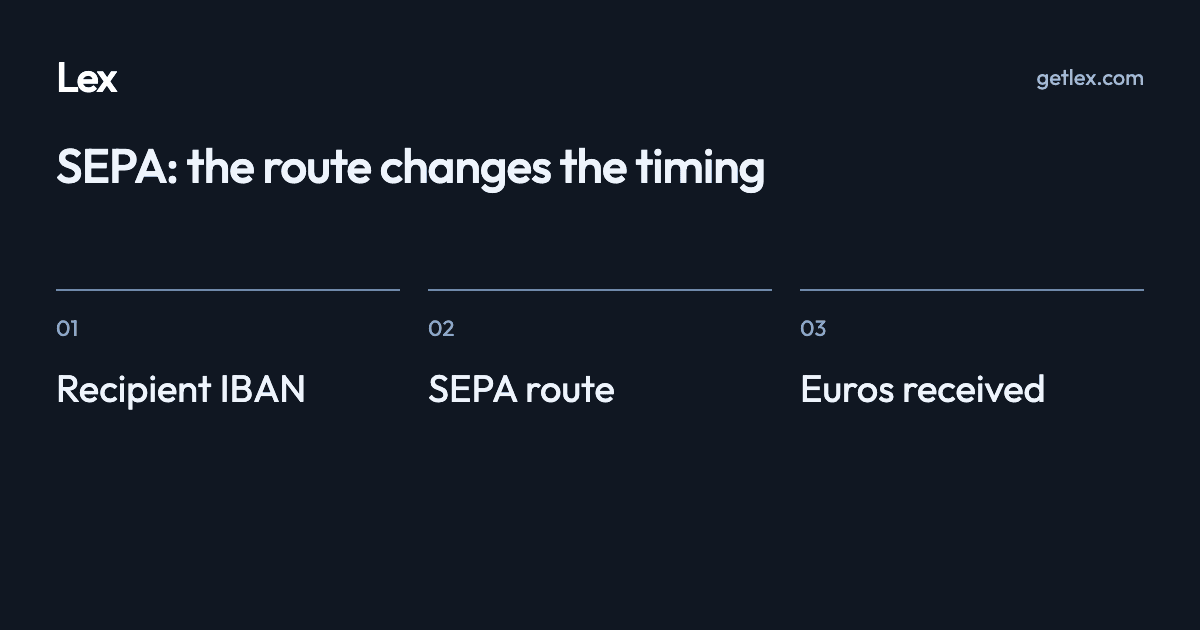
One currency, many participating countries
SEPA stands for Single Euro Payments Area. Its credit-transfer schemes provide common rules for euro payments between participating accounts. This makes a payment to another participating country more familiar than arranging a traditional international wire. SEPA is about the payment area and currency; it is not a rule that every transfer involving Europe uses euros.
If you pay from an account holding another currency, your bank may need to convert money before sending the euro transfer. That conversion is a separate part of the cost. Similarly, sending euros to a service that later pays Mexican pesos involves more than the SEPA step. The local recipient does not receive euros simply because the funding originated in Europe.
For a consumer, start with three questions: does the receiving account accept this SEPA payment, how much will leave my account, and what balance will become available at the other end? The answers are more useful than assuming that every European account supports the same options.
Copy the IBAN and the beneficiary correctly
An IBAN is an international bank account number. Its structure includes a country code and check digits, followed by account information in a country-specific format. Length varies by country. Copy it from the current receiving instructions, and do not remove a leading zero from the account information. Spaces may be displayed for readability without being part of the underlying identifier.
Use the beneficiary name supplied by the receiving institution or provider. If your bank shows a name-check warning, resolve it before sending. A valid IBAN format does not prove the recipient is the person you intended. Unexpected changes to bank details should be confirmed through a trusted contact method.
Include any required reference. For a provider deposit, that reference can connect the bank payment to your operation. If the form requests a BIC or additional details, obtain them from the instructions rather than guessing from the bank’s name. Keep the confirmation and the exact information used until the receiving balance is available.
Ordinary SEPA and SEPA Instant are distinct
Ordinary SEPA credit transfers follow business-day processing. An electronic transfer generally reaches the receiving payment provider by the next business day after the order is received, with cutoffs affecting when that clock starts. SEPA Instant is a distinct scheme designed to make euros available within seconds, around the clock, subject to its rules and service availability.
Do not assume that an IBAN alone tells you which scheme a provider accepts. Your bank’s instant option and the receiving account’s supported route both matter. If an instant attempt fails or is unavailable, read the bank’s proposed alternative before accepting a switch to an ordinary transfer.
For a Friday payment, ordinary processing may extend beyond the weekend, while an available instant transfer has a different timetable. A service can still need to identify your deposit, perform checks, or convert it after receipt. The bank network’s processing time and the provider’s wallet-crediting time should be considered separately.
What “instant” and “low cost” do not tell you
European rules address access to instant euro payments and their pricing relative to corresponding ordinary transfers, with obligations depending on the provider and applicable timetable. That does not make every international journey free. Your own account terms, any currency conversion, and a later withdrawal can still determine the total cost.
Compare the total euros debited with the net currency that the recipient can use. If a provider quotes a fee separately from the exchange rate, include both. If the quote already deducts a cost from the receiving amount, do not subtract it again. Ask for clarification whenever the screen does not make that treatment clear.
A useful record includes the time of the quote, the amount, the funding method, and the payout method. A promotional price for a first transfer should not be treated as the permanent monthly cost. For recurring support to family, compare a normal repeat transaction as well as any introductory offer.
The SEPA route available in Lex
Lex’s euro bank route is identified as SEPA. This does not, by itself, establish support for SEPA Instant. In Transfers, choose receiving, enter the amount, and continue to bank transfer when available. Select euros and follow the account’s current instructions, including verification, beneficiary, IBAN, and reference when requested.
Review the quoted result and any conversion before sending. A euro bank deposit is not automatically a direct deposit of EURC into your wallet. The flow should tell you what you are funding and the expected credited balance. Use that information instead of choosing a method solely because the currency labels look similar.
For an outgoing bank payment, check the separate send options for your account and recipient. Access depends on the provider, eligibility, and operation. Keep the bank confirmation and Lex record so a delayed deposit can be investigated. If the supported route is ordinary SEPA, plan around its estimate instead of assuming a faster scheme will be accepted.
From a euro salary to family in Argentina
Sofía in Spain wants to send money to her father in Argentina. Before transferring euros, she checks that her Lex account offers the needed funding and Argentine peso payout routes. Her father provides the CBU or CVU requested by the payout form, and they confirm his name and the destination account.
Sofía compares services using the same total euro budget and the same Argentine bank or wallet-account endpoint. She records expected net pesos after all quoted costs. She also checks the quote’s validity, because the final amount may change if funding arrives later and a new conversion quote is needed. An estimate today is not necessarily a rate reserved until next week.
After the euro deposit becomes available, she reviews the current payout and confirms. Her father checks the credit in his own account. The useful advantage of the route is combining familiar euro funding with a supported local destination. Its success is measured by the usable pesos delivered and the full cost and time required to get them there.