Payments
ACH: understanding US bank transfers
Why an ACH transfer can stay pending, how business days affect it, and what to check when funding Lex.
The familiar transfer with an unfamiliar name
ACH stands for Automated Clearing House. It is the US network behind many salary deposits, bill payments, and bank-to-bank transfers. The payment usually uses a routing number and an account number. Unlike a card purchase, it moves through bank payment instructions and scheduled processing rather than a card authorization at checkout.
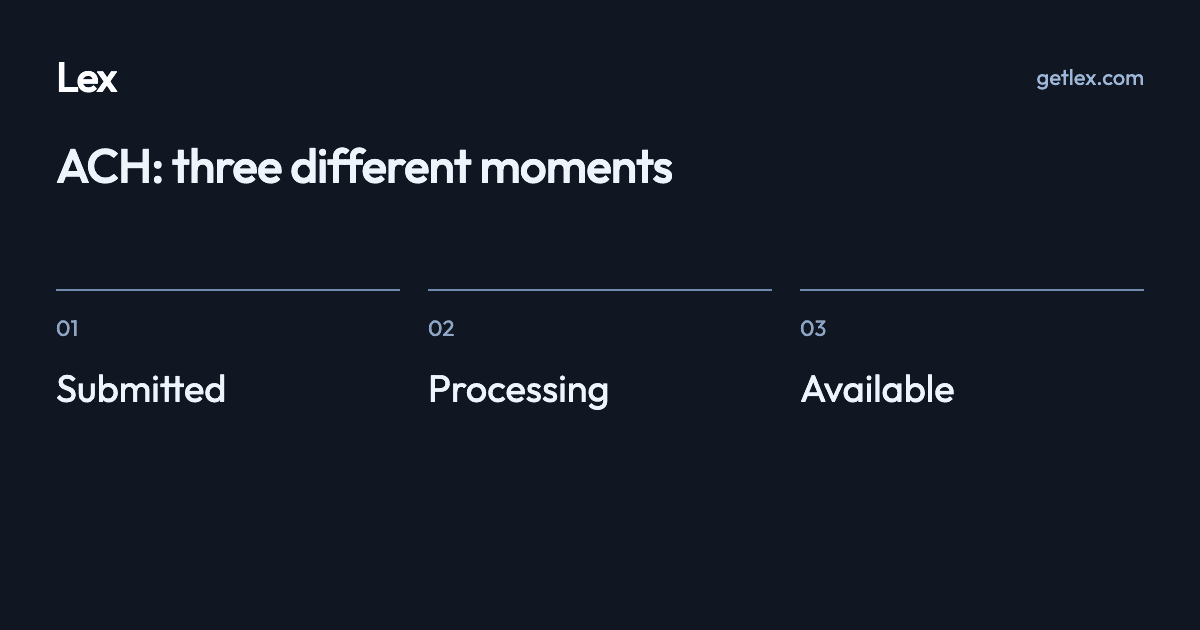
For a consumer, the important distinction is between asking for a transfer and having usable money at the destination. A bank may show a deduction, a scheduled payment, or a pending transaction before the receiving service makes the funds available. Those labels describe stages; they are not interchangeable promises about when you can spend.
ACH can be a useful funding option when you can plan ahead. If you are sending money to family in Mexico, Brazil, or Argentina, the US funding stage may determine the overall delivery date even when the local payout system is fast. Start the comparison at your US account, not at the later conversion screen.
Sending money versus authorizing a debit
An ACH credit generally means the sender tells their bank to push money to a destination. An ACH debit means a business or service collects money under an authorization. They can feel similar in an app, but they are different instructions, and a receiving account might accept one without accepting the other.
When Lex gives you bank deposit details, follow the funding directions provided for that account. Do not assume that entering those details into any account-linking service will work. A service that tries to verify ownership with small debits or pulls may not be compatible with an account intended for incoming credits.
Use the stated beneficiary name, routing number, account number, account type, and reference if one is supplied. Check whether the bank distinguishes its ACH routing number from its wire routing number. If instructions restrict who may send, follow that restriction; having valid numbers does not authorize every sender or payment type.
Standard ACH, Same Day ACH, and the calendar
Standard ACH and Same Day ACH use different processing schedules. Same-day processing is an option for eligible payments submitted within the relevant windows; it is not a promise that every bank-transfer button sends instantly. Your bank decides which service it offers to you and when it stops accepting instructions for that day.
A business day is not simply the next date on the calendar. Weekends and bank holidays can affect processing. A transfer entered late on Friday may only begin its next processing stage on a following banking day. The sender’s app should show an estimated arrival or processing date, and the receiving provider may have its own availability estimate.
For example, if you need a recipient paid on Monday, do not work backward only from a fast local payout. Check the US bank’s cutoff and holiday calendar first. If the estimate misses the deadline, consider an available alternative before initiating the ACH transfer. Changing methods afterward can leave two payments in progress.
What a pending transfer means
Pending can mean the instruction is queued, the bank is processing it, or the recipient is waiting for checks to finish. It does not identify the cause on its own. Compare the expected date with the transaction status and check whether the service has asked for more information. Keep enough money in the funding account until the debit or outgoing payment is complete.
If the estimate has passed, gather the amount, initiation date, beneficiary, and bank confirmation or trace number. Contact the institution responsible for the stage that is delayed. A provider cannot investigate a transfer precisely from a message saying only that money was sent yesterday.
ACH also has return and dispute processes that differ from an irreversible wallet transfer. Funds shown provisionally by a service may still be affected by a return. Do not interpret an early balance display as proof that the underlying bank payment can never fail. Ask what is available to use, not just what is visible.
Funding Lex with the instructions on your account
In Lex, begin a receive operation in Transfers, enter the amount, and choose bank transfer if offered. Select the US dollar ACH / Wire route and complete the requested verification. Open the account’s deposit instructions and choose the information appropriate to ACH. Copy from the current screen rather than an old message or a screenshot from someone else’s account.
Review which balance will be credited and whether conversion is part of the operation. A dollar bank deposit and a dollar stablecoin balance are different forms of money. The bank payment has to be received and processed before the resulting wallet funds can be used as indicated by the service.
Lex’s available funding methods depend on your account and the provider. The ACH / Wire label does not promise Same Day ACH, a particular funding fee, or immediate availability. Use the instructions and estimates shown for your operation. Keep its record until the balance is available and the later payment, if any, is complete.
A monthly payment from Chicago to Mexico
Diego plans to help his sister in Mexico with rent every month. Instead of starting the US bank transfer on the rent deadline, he checks the ACH estimate in advance and builds his schedule around it. Before funding, he also verifies that the desired Mexican bank payout is available and that his sister’s CLABE is correct.
He compares services using the same total dollar budget. For Lex, that means including any funding cost, conversion cost, and bank payout cost. If a competitor gives one all-in peso quote, Diego compares it with the net pesos expected through the complete Lex route, rather than with a headline exchange rate or a wallet-only amount.
After ACH funding becomes available, he reviews a fresh payout quote. If he decides to keep some funds for next month, he recognizes that holding a stablecoin introduces issuer and wallet risks, while holding a different currency introduces exchange-rate risk. Planning can make the process easier; it should not require assuming that every balance is identical to a bank deposit.