Payments
International wires—and the Lex alternative
Understand correspondent banks, conversion costs, and how local transfers plus stablecoins can offer another route.
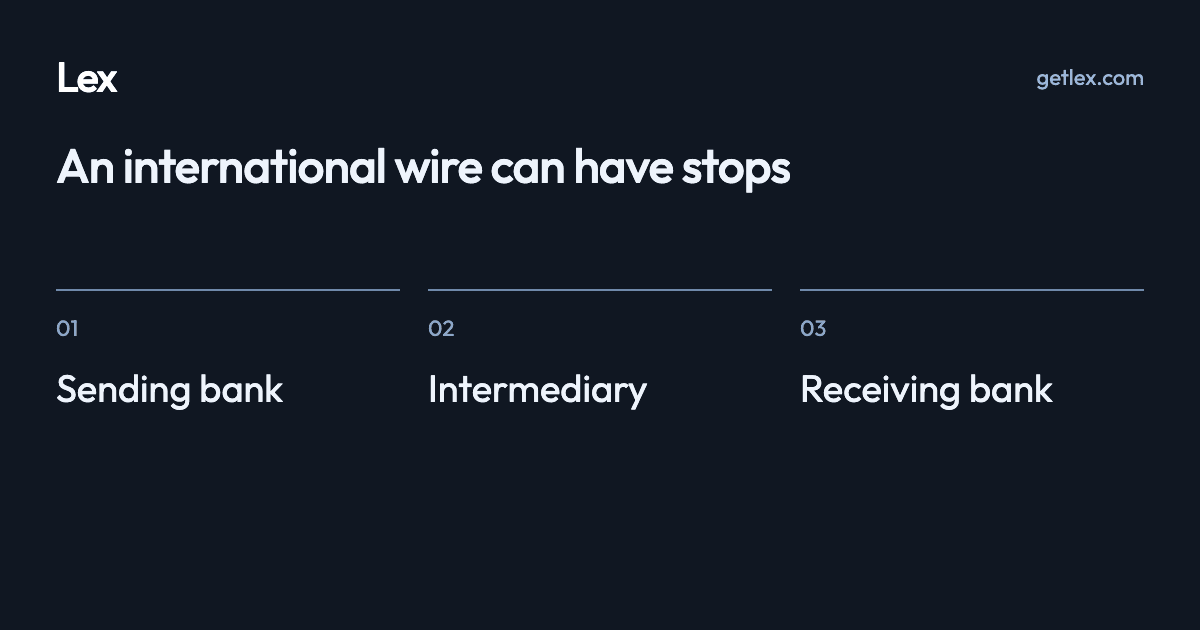
Why a transfer can involve more than two banks
An international wire connects a sending account with a receiving account in another country. When their banks do not have the necessary direct relationship, an intermediary or correspondent bank can help move the payment. Swift provides financial messaging used in many of these journeys; it is not a consumer account holding your transfer balance.
The recipient’s bank may provide a bank identifier, account details, beneficiary address, and sometimes intermediary instructions. Use the complete current instructions for the intended currency. Sending dollars to an account that expects local currency can involve conversion or rejection, depending on the account and service.
Traditional wires can be useful for destinations, amounts, or documentation requirements that another service does not cover. Their broad banking reach is a real advantage. The task is to understand the route you are offered, including timing and costs, rather than treating every wire as slow or every newer alternative as automatically better.
Three places where the amount can change
First, the sending institution may charge a transfer fee. Second, currency conversion can affect the amount through the exchange rate and any explicit conversion charge. Third, an intermediary or receiving institution may make a deduction or charge the recipient. Ask which amounts are included in the quote and which remain uncertain.
Some banks offer charge instructions described as sender pays, shared charges, or beneficiary pays, sometimes using OUR, SHA, and BEN labels. The available options and their effect depend on the bank and route. A label should not replace asking whether the recipient amount is guaranteed and what exceptions or additional charges apply.
A zero sending fee does not establish a zero-cost transfer. Conversely, a visible fee does not prove the route is expensive if the exchange rate and final proceeds are competitive. The meaningful comparison is the total paid at origin against the amount available for use at destination, using the same currencies and delivery method.
A small example of the complete calculation
Consider a purely illustrative transfer with a total budget of US$500. Suppose US$10 pays an upfront fee and US$490 is converted at 17 Mexican pesos per dollar. That produces MX$8,330 before any destination deduction. If a further MX$50 is taken at the receiving end, the recipient can use MX$8,280.
These numbers are an arithmetic example, not a current quote from Lex or a bank. They show why multiplying the original US$500 by the displayed exchange rate would overstate what arrives. They also show why a fair comparison cannot mix a budget that includes fees with another provider’s principal amount before fees.
When collecting actual quotes, record the date and time, origin account, funding method, total debit, receiving currency, and payout method. Ask whether the displayed recipient amount already includes deductions. Avoid counting the same fee twice. If a provider cannot determine a receiving-bank charge, keep that uncertainty visible in the comparison rather than silently treating it as zero.
How local transfers and stablecoins change the route
A supported Lex journey can use a local bank transfer to fund a wallet balance, a supported stablecoin or conversion step, and a local payout at the destination. The family member can receive local money if that bank route is available. They do not necessarily need to receive a token themselves.
This can reduce reliance on a chain of correspondent banks for that particular journey and make the conversion and payout easier to review in an app. It also introduces a different set of dependencies: stablecoin issuers, blockchain execution, liquidity, and the providers that connect bank accounts with wallet assets. Those steps still need to work together.
A blockchain confirmation establishes a transaction on that network, not completion of every bank step around it. Nor does a stablecoin guarantee its market price, redemption access, or a particular exchange rate into another currency. A good alternative is one whose total price, supported destination, and expected timing fit the actual payment.
Checking a complete route in Lex
Before moving money, check both ends in Lex. In Transfers, the receive path shows available funding methods, while the send path lets you choose an available destination and recipient. Complete the required verification. Use the current bank instructions, and distinguish the currency of your deposit from the wallet balance credited after processing.
For a bank payout, review the recipient details and the final local-currency quote. Include any conversions or withdrawals still needed to reach that recipient. If one end is unavailable for your account, a supported asset or a fast network elsewhere does not complete the route. Resolve the missing step before funding for that purpose.
Compare the full result with the wire quote from your bank. Lex may be attractive when you can use familiar local methods, see the conversion clearly, and receive money in the desired account. The comparison should remain open to a bank wire being more suitable for a particular amount, destination, or deadline.
A US or European sender, a Latin American recipient
Imagine a family dividing support among relatives in Mexico, Brazil, and Argentina. The sender checks each destination separately: a Mexican CLABE, a Brazilian Pix key, and an Argentine CBU or CVU are not interchangeable account details. Availability and pricing for one country do not establish the same result in another.
For each route, the sender compares total dollars or euros paid with net pesos or reais received and records the expected arrival. A euro deposit on a business-day schedule might dominate the timing even when the final local payment is rapid. A quote may need refreshing after funding, so the initial estimate should not be presented as a locked future rate.
If a wire is delayed, request tracking through the sending bank, including the payment reference or UETR where available. If a Lex operation is delayed, retain the funding receipt and operation identifier for the relevant stage. Clear records and realistic timing help the recipient plan around money that is actually available.